Attendance Management: Complete Guide for 2026

Attendance Management is the systematic process of tracking, recording, and managing employee work hours, presence, and time-off to ensure accurate payroll, workforce productivity, and regulatory compliance. It encompasses time tracking, shift scheduling, overtime monitoring, absence management, and comprehensive reporting that provides visibility into workforce utilization.
Beyond simply recording who showed up for work, modern Attendance Management is a strategic function that impacts operational efficiency, labor cost control, employee accountability, and business planning. It provides critical data for payroll processing, performance evaluation, resource allocation, and compliance with labor laws.
In today’s diverse work environment with remote teams, flexible schedules, and hybrid models, effective Attendance Management is essential for maintaining productivity, ensuring fairness, and optimizing workforce deployment across the organization.
The Strategic Impact of Tracking Time Effectively
Attendance is more than a daily ritual; it’s fundamental business data that drives multiple critical functions:
Payroll Accuracy: 80% of payroll errors stem from inaccurate attendance data. Precise time tracking ensures employees are paid correctly for hours worked, overtime, and leave taken.
Productivity Insights: Organizations with robust attendance tracking report 25% improvement in workforce productivity. Understanding attendance patterns helps identify inefficiencies and optimize resource allocation.
Cost Control: Labor typically represents 50-70% of operating costs. Accurate attendance management helps control overtime expenses, reduce time theft, and optimize staffing levels.
Compliance Protection: Labor laws mandate specific record-keeping for hours worked, breaks, overtime, and leave. Poor attendance records expose organizations to audits, penalties, and legal disputes.
Operational Planning: Attendance data reveals patterns in absenteeism, peak productivity hours, and staffing needs, enabling better scheduling and resource planning.
Employee Accountability: Transparent attendance tracking creates fairness, discourages time theft, and ensures consistent application of attendance policies across the organization.
From Manual Registers to Intelligent Tracking
Attendance Management has transformed significantly with technology advancement:
 Manual Registers:
Supervisors maintained handwritten attendance registers, noting arrivals, departures, and absences. This method was prone to errors, manipulation, and provided no real-time visibility.
Manual Registers:
Supervisors maintained handwritten attendance registers, noting arrivals, departures, and absences. This method was prone to errors, manipulation, and provided no real-time visibility.  Punch Card Systems:
Mechanical time clocks where employees inserted cards to stamp arrival and departure times. While more objective than manual registers, these systems were still prone to buddy punching and required manual compilation.
Punch Card Systems:
Mechanical time clocks where employees inserted cards to stamp arrival and departure times. While more objective than manual registers, these systems were still prone to buddy punching and required manual compilation.  Biometric Systems:
Fingerprint and facial recognition technology eliminated buddy punching and provided accurate identification. However, standalone devices required manual data extraction and consolidation.
Biometric Systems:
Fingerprint and facial recognition technology eliminated buddy punching and provided accurate identification. However, standalone devices required manual data extraction and consolidation. 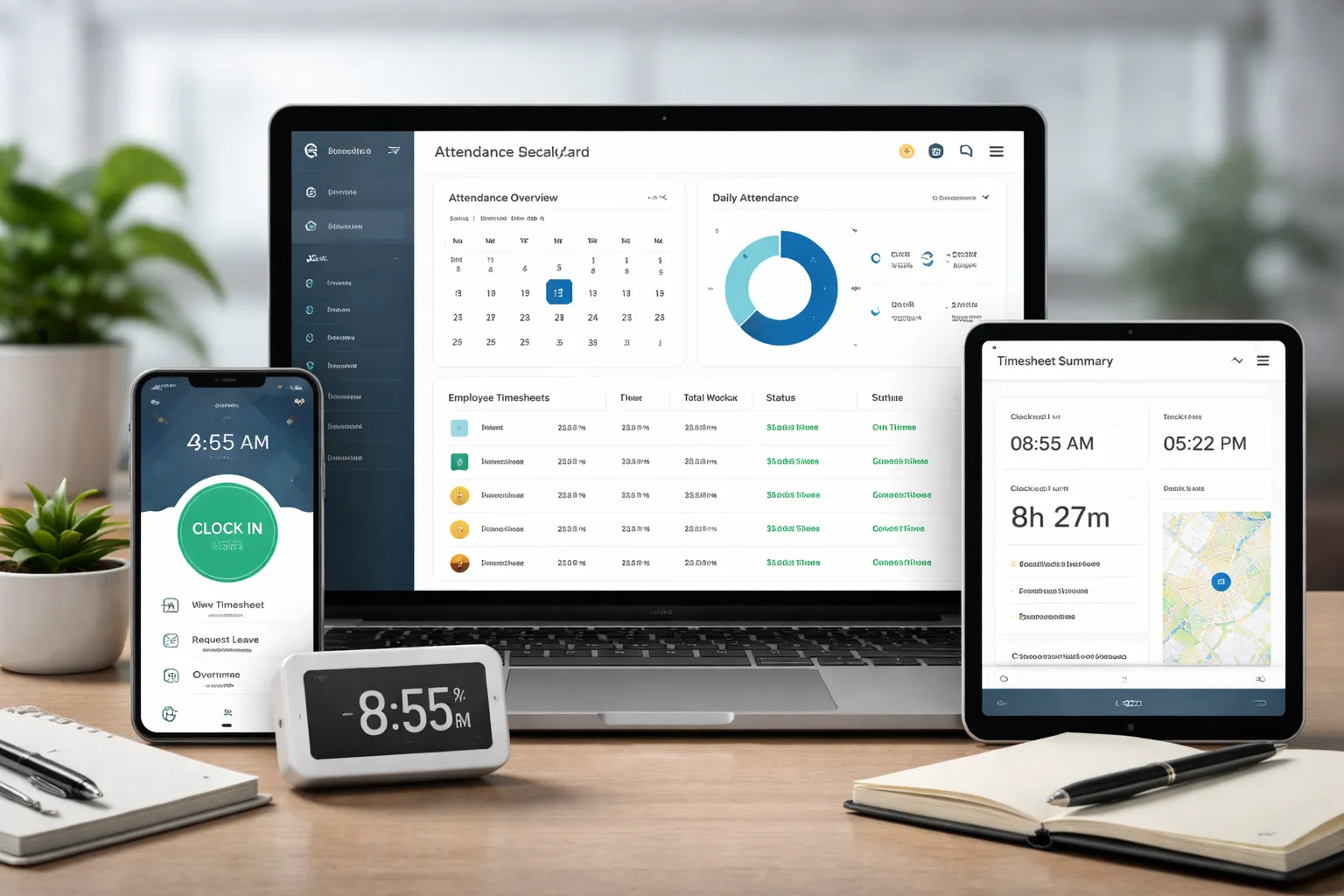 Software-Based Solutions:
Desktop and web-based attendance software automated data collection and reporting. Integration with payroll improved accuracy but still required employees to be at specific locations.
Software-Based Solutions:
Desktop and web-based attendance software automated data collection and reporting. Integration with payroll improved accuracy but still required employees to be at specific locations.  Cloud & Mobile Systems:
Cloud-based platforms with mobile apps enable attendance tracking from anywhere, support remote workforces, provide real-time dashboards, and integrate seamlessly with HRMS and payroll.
Cloud & Mobile Systems:
Cloud-based platforms with mobile apps enable attendance tracking from anywhere, support remote workforces, provide real-time dashboards, and integrate seamlessly with HRMS and payroll.  AI-Powered Future:
Artificial intelligence, geofencing, facial recognition, and predictive analytics are transforming attendance from reactive tracking to proactive workforce optimization and anomaly detection.
AI-Powered Future:
Artificial intelligence, geofencing, facial recognition, and predictive analytics are transforming attendance from reactive tracking to proactive workforce optimization and anomaly detection. Time Tracking Methods
Modern organizations need flexible tracking methods that accommodate diverse work environments.
Biometric Attendance: Fingerprint, facial recognition, or iris scanning devices provide the most accurate identification, completely eliminating buddy punching and time fraud. Ideal for office-based employees.
Mobile Clock-In/Out: GPS-enabled mobile apps allow employees to mark attendance from any location. Geofencing ensures employees are at designated work sites when clocking in, perfect for field teams and remote workers.
Web-Based Attendance: Browser-based clock-in allows employees to mark attendance from company computers or laptops. Suitable for office environments and remote workers on company devices.
Card/Badge Systems: RFID or proximity cards provide contactless attendance marking. Quick and hygienic, though susceptible to buddy punching if not combined with cameras or biometrics.
Kiosk Systems: Dedicated tablets or terminals where employees can clock in using PIN, badge, or biometric verification. Useful for shared workspaces and manufacturing floors.
Integration with Access Control: Automatic attendance capture when employees enter office premises using access control systems, providing seamless tracking without additional steps.
Shift Management
Effective shift management ensures adequate coverage while optimizing labor costs.
Shift Types: Configure multiple shift patterns including fixed shifts, rotating shifts, split shifts, flexible hours, and staggered timings based on business needs.
Shift Scheduling: Create weekly or monthly schedules, assign shifts to employees or teams, and handle last-minute changes efficiently. Visual scheduling interfaces simplify complex roster management.
Shift Allowances: Automatic calculation of shift-specific allowances such as night shift differential, weekend premium, or holiday pay based on when employees actually work.
Shift Rotation: Automated rotation patterns ensure fair distribution of less desirable shifts among team members, maintaining morale while meeting operational requirements.
Shift Swaps: Enable employees to request shift swaps with manager approval, providing flexibility while maintaining required coverage and compliance with labor laws.
Coverage Management: Real-time visibility into shift coverage helps identify gaps, prevent understaffing, and avoid excessive overtime costs from inadequate planning.
Overtime Management
Control overtime costs while ensuring compliance with labor regulations.
Overtime Rules: Configure overtime thresholds based on daily hours, weekly hours, or monthly hours according to local labor laws and company policy.
Automatic Calculation: System automatically identifies overtime hours when employees work beyond standard hours, applying appropriate multipliers (1.5x, 2x, 3x) based on day type and overtime category.
Overtime Approval: Require manager pre-approval for overtime work, preventing unauthorized overtime and controlling labor costs through proper authorization workflows.
Overtime Limits: Set maximum overtime limits per employee per day, week, or month to ensure compliance with labor laws and prevent employee burnout.
Compensatory Off: Track compensatory time off earned for overtime work, allowing employees to take equivalent time off instead of overtime pay when company policy permits.
Overtime Analytics: Detailed reports on overtime patterns by department, employee, or time period help identify cost-saving opportunities and optimize workforce planning.
Leave Integration
Seamless connection between attendance and leave management ensures accurate tracking.
Leave Deduction: Automatically adjust attendance records when approved leave is taken, ensuring payroll reflects actual working days accurately.
Half-Day Leave: Support for partial day leave with appropriate attendance marking, calculating actual hours worked and leave hours separately.
Leave Balance Impact: Real-time updates to leave balances as attendance is marked, providing employees and managers current information for planning.
Sandwich Leave: Identify and flag instances where employees take leave adjacent to weekends or holidays, if company policy requires special handling or approval.
Leave Calendar View: Integrated calendar showing both attendance and leave provides complete visibility into employee availability and team capacity.
Absence Patterns: Analytics identifying frequent absence patterns, Monday/Friday leaves, or suspicious leave trends that may require intervention.
Attendance Regularization
Handle exceptions and corrections while maintaining audit trails.
Regularization Requests: Employees can request corrections for missed clock-ins, early departures, or attendance errors with explanations and supporting documentation.
Approval Workflow: Manager review and approval of regularization requests with visibility into employee’s attendance history and pattern before approving exceptions.
Policy Limits: Configure maximum regularization requests allowed per month per employee to prevent abuse while accommodating genuine errors or emergencies.
Documentation: Require supporting documents (medical certificates, travel tickets, client meeting confirmations) for specific regularization types ensuring validity.
Audit Trail: Complete history of all regularization requests, approvals, rejections, and modifications for compliance audits and dispute resolution.
Bulk Regularization: Allow managers to apply attendance corrections for multiple employees simultaneously in cases of system failures or planned exceptions like team offsites.
Late Coming & Early Going
Monitor punctuality and manage attendance discipline effectively.
Grace Period: Configure grace periods for late arrivals (typically 5-15 minutes) before marking employees late, balancing strictness with reasonable flexibility.
Late Coming Policies: Define consequences for tardiness including verbal warnings, written warnings, salary deductions, or disciplinary action based on frequency and duration.
Early Departure Tracking: Automatic flagging when employees leave before scheduled shift end time, with appropriate approvals and policy enforcement.
Deduction Rules: Automatic salary deductions for unauthorized late arrivals or early departures based on company policy and actual time lost.
Exception Handling: Allow valid exceptions for late coming or early going with proper approval in cases of medical appointments, personal emergencies, or official work.
Punctuality Reports: Analytics on punctuality trends by employee, department, or location helping identify chronic issues requiring intervention.
Remote & Hybrid Work Tracking
Support modern work arrangements with appropriate tracking mechanisms.
Location Tracking: GPS-based verification ensures remote employees are at designated work locations when marking attendance, preventing fraud while respecting privacy.
Flexible Attendance: Support for flexible work hours where employees can start and end at different times within specified windows while meeting minimum daily hours.
Work From Home: Separate tracking for office days versus remote work days, providing visibility into hybrid work patterns and office utilization.
Activity Monitoring: Optional productivity tracking tools measuring active work time, application usage, or task completion for remote employees when company policy requires.
Virtual Check-ins: Scheduled virtual check-ins or status updates for remote teams ensuring engagement and availability without micromanagement.
Timezone Management: Automatic handling of different timezones for globally distributed teams, converting all times to company standard for consistent reporting.
Compliance & Labor Law Adherence
Ensure attendance practices comply with local, state, and national regulations.
Working Hours Limits: Automatic monitoring to ensure employees don’t exceed maximum daily or weekly working hours mandated by labor laws.
Rest Periods: Tracking mandatory rest periods between shifts, daily breaks, and weekly offs ensuring compliance with labor regulations and preventing violations.
Record Retention: Maintaining attendance records for legally mandated periods (typically 3-7 years) in auditable formats for labor department inspections.
Minor Employee Restrictions: Special tracking and restrictions for employees under 18 ensuring compliance with child labor laws regarding working hours and timing.
Overtime Regulations: Adherence to overtime calculation methods, maximum overtime limits, and mandatory rest after continuous work as per local labor laws.
Audit Reports: Pre-formatted compliance reports showing adherence to working hour limits, rest periods, and overtime regulations for labor department audits.
Reporting & Analytics
Transform attendance data into actionable business intelligence.
Daily Attendance Reports: Real-time visibility into who’s present, absent, on leave, or late enabling immediate operational decisions and coverage adjustments.
Monthly Attendance Summary: Comprehensive monthly reports showing total working days, present days, absent days, leave taken, and late coming instances for payroll processing.
Absenteeism Analysis: Identify absence patterns by day of week, month, season, or employee group helping predict and plan for expected absences.
Overtime Reports: Detailed overtime analysis by employee, department, or cost center showing costs and trends for budget management and optimization.
Punctuality Metrics: Track late arrivals and early departures across the organization, identifying departments or individuals requiring attention.
Department-wise Reports: Compare attendance metrics across departments, locations, or teams to identify best practices and areas needing improvement.
Trend Analysis: Historical attendance data visualization showing patterns over months or years, supporting workforce planning and policy decisions.
Custom Reports: Flexible report builder allowing HR teams to create specific reports matching their unique analysis needs and export in multiple formats.
Attendance Management Challenges
Buddy Punching: Employees marking attendance for absent colleagues costs businesses billions annually. Traditional punch cards and manual registers are particularly vulnerable to this fraud.
Data Accuracy: Manual attendance tracking results in 5-10% error rates from illegible handwriting, calculation mistakes, or intentional manipulation affecting payroll and compliance.
Remote Work Tracking: Traditional attendance systems designed for physical presence struggle to accommodate work-from-home, hybrid schedules, and distributed teams effectively.
Multiple Locations: Organizations with offices across cities or countries face challenges consolidating attendance data from different systems, timezones, and work policies.
Integration Gaps: Standalone attendance systems require manual data transfer to payroll, creating inefficiency, errors, and delays in salary processing.
Real-Time Visibility: Manual systems provide no real-time insight into current attendance, making it impossible to address coverage gaps or operational issues promptly.
Policy Enforcement: Consistently applying attendance policies across large organizations is difficult without automated systems that enforce rules fairly and transparently.
Compliance Risk: Inadequate attendance records expose organizations to labor law violations, audit failures, and legal disputes over working hours and overtime.
Employee Queries: Manual attendance systems generate constant employee queries about their attendance records, consuming HR time and creating dissatisfaction.
Reporting Complexity: Generating attendance reports from manual records is time-consuming and error-prone, limiting ability to analyze trends or make data-driven decisions.
How Technology Transforms Time Tracking
Digital attendance management leverages technology to eliminate fraud, ensure accuracy, and provide strategic insights.
Biometric Authentication: Fingerprint, facial recognition, and iris scanning completely eliminate buddy punching and time fraud, ensuring only the actual employee can mark attendance.
Automated Data Capture: Integration with biometric devices, mobile apps, and access control systems automatically captures attendance without manual intervention or data entry.
Real-Time Dashboards: Live visibility into who’s present, absent, or late across all locations enables immediate operational decisions and rapid response to coverage issues.
GPS Verification: Mobile attendance with GPS tracking ensures field employees and remote workers are at designated locations when marking attendance, preventing location fraud.
Seamless Payroll Integration: Automatic flow of attendance data to payroll systems eliminates manual data transfer, reduces errors, and ensures accurate salary calculations.
Cloud Accessibility: Access attendance data from anywhere on any device. Cloud systems provide security, automatic backups, and support for distributed teams.
Intelligent Alerts: Automatic notifications for late arrivals, missed clock-outs, overtime thresholds, or unusual patterns enable proactive intervention before issues escalate.
Self-Service Access: Employees view their own attendance records, apply for regularization, and track their hours anytime, reducing HR queries by 70%.
Policy Automation: System automatically applies attendance policies including grace periods, late deductions, and overtime calculations consistently across the entire organization.
Advanced Analytics: Transform attendance data into insights about productivity patterns, absenteeism trends, and workforce utilization supporting strategic planning.
“ Moxiego’s Attendance Management module is designed to track employee work hours accurately, automate attendance processes, and ensure compliance while improving workforce visibility and efficiency. ” Miinfotech
Proven Strategies for Effective Time Tracking
Choose Right Technology: Select attendance systems matching your work environment. Biometric for office-based, mobile for field teams, and hybrid solutions for flexible workforces.
Clear Policies: Document comprehensive attendance policies covering work hours, breaks, overtime, late coming, regularization, and consequences. Communicate policies clearly to all employees.
Automate Everything: Invest in systems that automate data capture, calculations, policy enforcement, and reporting. Automation eliminates 90% of attendance-related errors and disputes.
Integrate Systems: Connect attendance with leave management, payroll, and HR systems. Integration ensures data consistency and eliminates duplicate data entry.
Regular Audits: Conduct periodic attendance audits to verify system accuracy, identify policy violations, and ensure compliance with labor laws and company standards.
Employee Training: Train employees on proper clock-in procedures, regularization processes, and attendance policies. Clear understanding prevents confusion and disputes.
Manager Accountability: Make managers responsible for monitoring team attendance, approving regularizations promptly, and addressing attendance issues proactively.
Fair Enforcement: Apply attendance policies consistently across all levels and departments. Inconsistent enforcement breeds resentment and undermines policy credibility.
Privacy Balance: While tracking attendance, respect employee privacy. Avoid excessive monitoring that creates mistrust, especially for remote and hybrid workers.
Continuous Improvement: Regularly review attendance data to identify process gaps, update policies, and optimize systems based on changing business needs.
Quantifying the Business Impact
Eliminate Time Theft: Buddy punching and time padding cost businesses 2-8% of payroll. A company with $5M annual payroll could lose $100,000-400,000 annually. Biometric attendance eliminates this entirely.
Payroll Accuracy: Automated attendance integration reduces payroll errors by 80%, preventing overpayments, underpayments, and the administrative cost of corrections averaging $50-200 per error.
Administrative Time Savings: Automated attendance tracking saves HR teams 15-25 hours monthly on data compilation, error correction, and query resolution, worth $7,500-15,000 annually.
Overtime Cost Control: Real-time overtime monitoring and approval workflows reduce unauthorized overtime by 30-40%, saving thousands monthly for organizations with significant overtime.
Improved Productivity: Organizations with robust attendance tracking report 15-25% improvement in workforce productivity through better accountability and resource optimization.
Compliance Protection: Proper attendance records prevent labor law violations that can result in penalties of $1,000-10,000 per violation. Good records also protect against wrongful termination claims.
Reduced Absenteeism: Transparent attendance tracking reduces unplanned absences by 20-35% as employees become more accountable for their attendance.
Better Planning: Accurate attendance data enables better workforce planning, reducing overstaffing costs and understaffing disruptions that impact customer service and revenue.
A Framework for Success
Step 1: Assess Current State Evaluate existing attendance processes, identify pain points, measure current error rates, and understand specific challenges in your work environment.
Step 2: Define Requirements Specify your needs based on workforce type (office, field, remote, hybrid), number of locations, shift complexity, integration requirements, and compliance obligations.
Step 3: Select Technology Choose attendance systems matching your requirements. Consider biometric devices for offices, mobile apps for field teams, and cloud platforms for centralized management.
Step 4: Design Policies Create clear attendance policies covering work hours, grace periods, overtime rules, regularization procedures, and disciplinary actions aligned with labor laws.
Step 5: Implement System Deploy hardware and software, configure policies and workflows, integrate with existing systems, and conduct parallel runs to ensure accuracy before full rollout.
Step 6: Train Organization Comprehensive training for employees on marking attendance, HR teams on system management, and managers on monitoring and approval responsibilities.
Step 7: Monitor & Optimize Track system adoption, measure accuracy, gather feedback, identify issues, and continuously refine processes and policies for optimal results.
What to Look for in Time Tracking Software
Multiple Tracking Methods: Support for biometric devices, mobile apps, web clock-in, and card systems accommodating different work environments and employee types.
Real-Time Visibility: Live dashboards showing current attendance status across all locations enabling immediate operational decisions and coverage management.
Flexible Shift Management: Robust shift scheduling, rotation patterns, swap requests, and coverage tracking supporting complex operational requirements.
Automated Calculations: Automatic overtime calculation, late deductions, shift allowances, and attendance summaries eliminating manual calculations and errors.
Seamless Integration: Native integration with leave management, payroll, and HRMS ensuring data consistency and eliminating duplicate entry.
Mobile Capability: Feature-rich mobile apps for marking attendance, viewing records, applying regularization, and managing teams on the go.
Geofencing & GPS: Location verification for mobile attendance ensuring field employees and remote workers are at designated locations.
Policy Automation: Configurable rules engine that automatically applies grace periods, overtime thresholds, approval workflows, and deductions consistently.
Comprehensive Reporting: Pre-built and custom reports covering daily attendance, monthly summaries, absenteeism analysis, overtime tracking, and compliance documentation.
Employee Self-Service: Portal access for employees to view attendance records, request regularization, and track their time without HR intervention.
Audit Trail: Complete logging of all attendance events, regularizations, approvals, and modifications for compliance audits and dispute resolution.
Scalability: Solution grows with your organization from 10 to 10,000+ employees across multiple locations without performance degradation.
The Complete Time Tracking Solution
Moxiego delivers comprehensive attendance management that combines accuracy, flexibility, and intelligence in one powerful platform.
Flexible Tracking Options: Support for biometric devices, mobile GPS attendance, web clock-in, and access control integration accommodating any work environment.
Real-Time Attendance Visibility: Live dashboards show exactly who’s present, absent, or late across all locations enabling immediate operational decisions.
Intelligent Shift Management: Create complex shift schedules, manage rotations, handle swaps, and ensure optimal coverage with visual scheduling tools.
Automatic Overtime Tracking: System identifies overtime hours, applies correct multipliers, requires approvals, and integrates seamlessly with payroll.
Seamless Payroll Integration: Attendance data flows automatically to payroll ensuring accurate salary calculations without manual intervention or errors.
Employee Self-Service: Empower employees with mobile and web access to view attendance, apply for regularization, and track their hours anytime, anywhere.
Complete Compliance: Built-in labor law compliance for working hours, overtime limits, rest periods, and record retention ensuring audit readiness.
Advanced Analytics: Transform attendance data into insights about productivity patterns, absenteeism trends, and workforce optimization opportunities.